Why Some People Don't Accept Calendar Invites — And How to Change That
You send a calendar invite. Days pass. No response.
The meeting is tomorrow. You still don't know if they're coming. So you fire off a Slack message, an email, maybe a text. Some people respond. Others don't. You walk into the meeting unsure of who's actually going to be there.
This scenario plays out millions of times every day in companies of every size. And most people treat it as a minor inconvenience — just the way things are.
It isn't minor. And it doesn't have to be this way.
The disrespect we've normalized
Imagine walking up to a colleague in the hallway and saying, "Hey, can you come to the planning meeting on Thursday?" Now imagine they look at you, say nothing, and walk away.
That's exactly what happens when someone ignores a calendar invite.
A calendar invitation is a formal request for someone's time. It includes a specific date, a specific time, and an implicit question: will you be there? When someone doesn't respond, they're telling you — whether they mean to or not — that your meeting isn't worth the three seconds it takes to click Accept or Decline.
We've normalized this behavior because it happens digitally. But the psychology behind non-response is the same whether it's in person or on a screen. It's a breakdown in professional communication that has real consequences.
Why people don't respond
Before we fix the problem, it helps to understand why it happens:
They intend to respond later and forget. This is the most common reason. The invite arrives during a busy morning. They glance at it, think "I'll deal with that after lunch," and it disappears into the noise. A study by Microsoft found that the average worker switches tasks every 3 minutes — it's no wonder calendar invites get lost.
They assume not responding means "yes." Some people treat calendar invites like FYI notices. They plan to attend but never explicitly confirm. They don't realize the organizer needs that confirmation to plan effectively.
They're avoiding commitment. If they're not sure they can make it, clicking "Tentative" or "Decline" feels like a commitment they're not ready to make. So they do nothing — the path of least resistance. As we've explored in why "Tentative" is the most dishonest word in your calendar, even a half-response is better than no response.
The invite was unclear. If the meeting title is vague ("Sync" or "Catch-up"), there's no agenda, and the purpose isn't obvious, people deprioritize it. Invites that clearly explain why the attendee is needed get dramatically higher response rates.
Calendar overload. According to research by Reclaim.ai, the average professional attends 25.6 meetings per week. When your calendar is wall-to-wall, individual invites blur together and responses fall through the cracks.
The real cost of not knowing
When people don't respond to meeting invites, the costs ripple outward in ways most organizations never quantify.
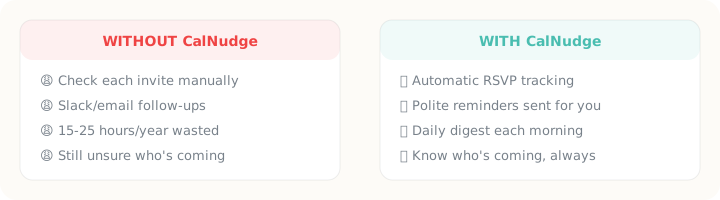
Wasted preparation. You prepared a presentation assuming all six stakeholders would attend. Two didn't show. The meeting can't achieve its purpose without their input, so you schedule another one. Your prep time was wasted — twice. The hidden cost of unanswered meeting invites adds up to 15-25 hours per year for the average professional.
Overbooked resources. You reserved a conference room for 12 people. Seven showed up. Meanwhile, another team couldn't find a room because yours was "full." In companies with tight office space, this isn't a minor inefficiency — it's a systemic problem. A study by Condeco found that 40% of booked meeting rooms go unused or underutilized because attendance doesn't match the invite list.
Delayed decisions. The meeting was called to make a decision. The decision-maker didn't respond to the invite and didn't show up. Now the decision gets pushed to next week. The project stalls. Multiply this across an organization and you get what researchers call "organizational drag" — the accumulated weight of delayed decisions that slows everything down.
Cascading no-shows. When one person doesn't respond, others take it as a signal that the meeting isn't important. Low RSVP rates are contagious. If the norm in your organization is that people don't bother responding, new employees adopt that norm within weeks.
The true cost of a no-show isn't just the wasted hour. It's the wasted preparation, the delayed decision, the rescheduled meeting, and the erosion of trust between colleagues.
It's a culture problem — and culture can be changed
The good news is that RSVP behavior is a habit, not a personality trait. Organizations that deliberately build a culture of calendar accountability see dramatic improvements in meeting effectiveness.
Here's what that looks like in practice:
Leadership sets the standard. When executives respond to calendar invites promptly — accepting, declining, or proposing alternatives — it signals to the entire organization that this behavior matters. Culture flows downward. If the CEO doesn't respond to invites, nobody will.
Make expectations explicit. Add a simple line to your company's meeting guidelines: "Please respond to all calendar invitations within 24 hours. If you can't attend, decline so the organizer can adjust." Most people don't ignore invites out of malice. They just don't realize it matters. Telling them directly changes behavior.
Provide context in every invite. Vague invites get vague responses (or none). Every calendar invitation should include: a clear title, an agenda or purpose statement, who's expected and why, and an explicit request to respond. This isn't just good meeting hygiene — it's how you write invitations that actually get responses.
Reduce meeting volume. Sometimes low response rates are feedback. If people are drowning in meetings, they stop responding because they've hit capacity. Before demanding better RSVP behavior, ask whether every meeting on the calendar actually needs to happen. Cutting meetings in half naturally improves the response rate for the meetings that remain.
A practical action plan
Here are seven specific actions you can take this week to improve calendar invite acceptance in your organization:
1. Audit your own invites. Look at your last 10 calendar invitations. Do they have clear titles? Agendas? A reason for each attendee to be there? If not, start there.
2. Set a team norm. In your next team meeting, say: "Going forward, let's all commit to responding to calendar invites within 24 hours — even if the answer is Decline." This simple statement changes behavior because it makes the expectation explicit.
3. Follow up proactively. Don't wait until the meeting to discover who's coming. Check your invite 48 hours before and reach out to non-responders. This is the art of the follow-up — a well-timed, polite nudge that gets results without creating friction.
4. Automate the reminders. Manual follow-up doesn't scale. CalNudge connects to your Google Calendar or Microsoft Outlook and automatically sends friendly reminders to attendees who haven't responded — for both internal and external meetings. It's inexpensive, takes 15 seconds to set up, and handles the reminder work for people who simply forget. No more chasing RSVPs manually.
5. Right-size your meetings. Only invite people who genuinely need to be there. Every unnecessary attendee is one more person who might not respond and one more person who might not show. Smaller meetings with the right people consistently outperform large meetings where half the attendees are optional.
6. Track your metrics. Start measuring your team's RSVP response rate. If you use CalNudge, the analytics dashboard shows your response rate over time, no-show trends, and which attendees consistently don't respond. You can't improve what you don't measure.
7. Gather feedback. After important meetings, ask attendees: was this meeting useful? Did the right people attend? This closes the loop and helps you continuously improve — not just attendance, but meeting quality itself.
The external meeting challenge
Everything above applies to internal meetings where you have some cultural leverage. External meetings — with clients, vendors, prospects, and partners — are harder because you can't control their culture.
This is where automated reminders become essential. You can't send your client a company policy memo about RSVP behavior. But you can ensure they receive a polite, well-timed reminder that puts your meeting back on their radar.
Whether you're a sales team chasing prospects for demo confirmations, a recruiter coordinating interviews across multiple parties, or a consultant managing client stakeholder meetings — the challenge is the same: people outside your organization don't share your commitment to calendar etiquette, and you need a system to bridge that gap.
Start with what you can control
You can't force people to respond to calendar invites. But you can:
- Write better invitations that deserve a response
- Set clear expectations within your team and organization
- Automate the follow-up so nothing falls through the cracks
- Measure your RSVP rates and track improvement over time
- Gather feedback to make every meeting worth attending
The organizations that take meeting culture seriously — that treat calendar invites as commitments rather than suggestions — are the ones where meetings actually work. Where decisions get made. Where people show up prepared and engaged.
It starts with a simple expectation: if someone invites you to a meeting, respond. And if your attendees aren't responding, give them a nudge.
Stop chasing RSVPs manually.
CalNudge automatically follows up with attendees who haven't responded — so you always know who's coming.
Get started free →