How Sales Teams Lose Deals to Meeting No-Shows
You booked the discovery call. You prepped the deck. You reviewed the prospect's LinkedIn profile and their company's latest earnings report. You're ready.
The meeting time arrives. You join the call. Nobody's there.
Five minutes pass. You send a quick "hey, are you joining?" message. Nothing. After ten minutes, you close the tab and move on to the next task — but the damage is already done.
The hidden cost to your pipeline
Every no-show on a sales call doesn't just waste 30-60 minutes of your time. It creates a cascade:
- Prep time wasted. You spent 20-30 minutes researching the account, customizing your pitch, and rehearsing your demo flow. That's gone.
- Momentum lost. The prospect was warm enough to book the call. Now you're starting the outreach cycle again — and they're cooler than before.
- Pipeline uncertainty. Is this deal still alive? Should you follow up or move on? Every ghosted call creates a forecasting question mark.
- Team resources burned. If you brought a solutions engineer or product specialist to the call, you've wasted their time too.
For a team running 50 meetings a week, that's 10-15 ghosted calls — every single week.
Why prospects ghost
It's rarely personal. Prospects don't think "I'll waste this rep's time today." What actually happens:
- The calendar invite got buried. They accepted during a busy morning, then forgot about it.
- Priorities shifted. Something urgent came up and your meeting wasn't top of mind.
- They were never fully committed. They said yes to be polite, not because they were ready to buy.
- No reminder hit their inbox. Calendar notifications are easy to dismiss. Without a personal follow-up, the meeting fades into the background.
What top sales teams do differently
High-performing sales teams don't just accept no-shows as a cost of doing business. They build systems to prevent them:
Pre-meeting confirmation. A friendly "looking forward to our call tomorrow" email sent 24 hours before the meeting. This alone can cut no-shows by 30-40%.
Multi-channel reminders. An email reminder the day before and morning of — personalized, not automated-feeling. The best ones reference something specific: "Excited to show you how [feature] addresses the [pain point] you mentioned."
Easy rescheduling. If someone can't make it, make it frictionless to reschedule rather than ghost. Include a reschedule link in your reminder.
Automated RSVP tracking. Know who's confirmed and who hasn't. If a prospect hasn't accepted the invite 48 hours before, that's your cue to reach out proactively — not wait and hope.
Automation changes the math
The challenge with manual confirmation is that it doesn't scale. An SDR running 8-10 meetings a day can't send personalized confirmation emails for each one. An AE managing 30 accounts can't track which invites are pending across all their calendars.
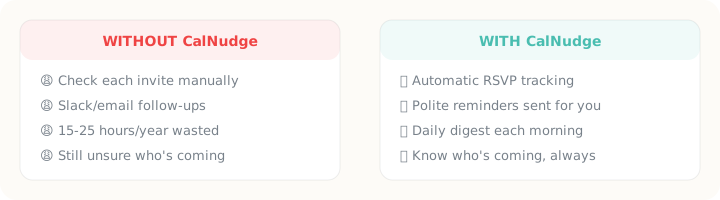
CalNudge for Sales Teams automates this entire flow. Connect your calendar and CalNudge monitors your upcoming meetings. Prospects who haven't responded get friendly, well-timed reminders — sent from your name, not a faceless tool.
You get a daily digest showing which meetings are confirmed, which are pending, and which need your attention. Instead of spending 20 minutes each morning chasing RSVPs, you spend 30 seconds scanning a summary.
The math on recovered deals
If automated reminders reduce your no-show rate from 25% to 10%, and you run 40 meetings a month, that's 6 recovered meetings. At a typical enterprise conversion rate, even one of those recovered meetings could be worth $10K-$100K+ in pipeline.
The ROI of preventing no-shows isn't just about saving time. It's about making sure the meetings that matter actually happen.
Stop chasing RSVPs manually.
CalNudge automatically follows up with attendees who haven't responded — so you always know who's coming.
Get started free →